
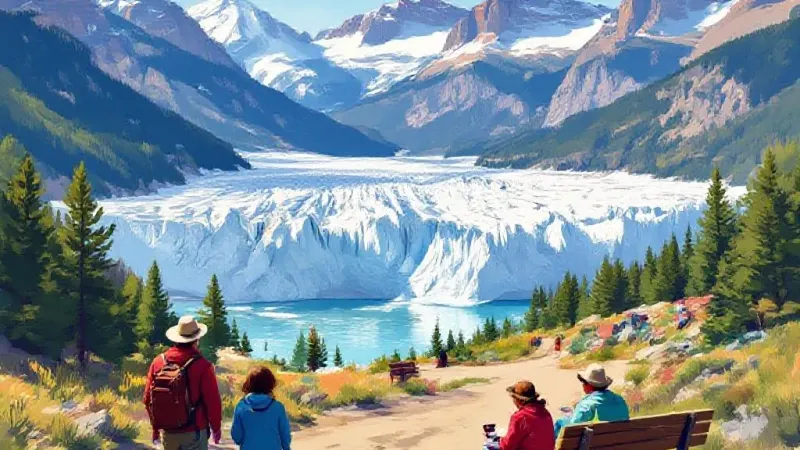
Estes Park, CO – Colorado's most prominent glaciers experienced dramatic thinning over the past year, driven by record low mountain snow and record warm temperatures in 2026. This significant shrinkage aligns with observations of accelerated glacier loss across the planet, posing threats to critical water sources, increasing mountain hazards, and contributing to sea level rise.
Glaciologist Dan McGrath at Colorado State University undertook research to specifically document changes during 2026, recognizing it as an exceptional year for the state. Colorado endured its worst snowpack on record, followed by record summer heat, which left the year-round ice masses in the Rocky Mountains exposed and vulnerable.
McGrath's findings reveal stark reductions. The Andrews Glacier thinned by more than 12 feet in this single year, while the Arapaho Glacier lost nearly 10 feet of ice. The Isabelle Glacier also saw a substantial loss of about 6.5 feet. These figures represent a doubling of their thinning rates from the prior five years. In the decade preceding that period, the annual thinning measured a foot or less per year, highlighting the accelerated pace of recent ice loss. Beyond the named glaciers, St. Mary’s Glacier, a perennial snowfield popular among hikers and skiers, melted completely in September of the same year.
McGrath stated that what is being witnessed is "the loss of that part of Colorado’s identity." He emphasized that this phenomenon is not unique to Colorado, noting consistent patterns of glacier loss in the Alps, other mountain ranges in the western United States, and globally. Worldwide, more than 7 trillion tons of ice have been lost since 2000, a slow-motion disaster that can sometimes lead to sudden, devastating events. For example, a massive section of rock and overlying glacier collapsed near Nepal’s border with China in August, resulting in over 1,300 fatalities.
The global context further underscores the urgency of these local observations. Glaciers in Switzerland lost 5.5% of their ice volume this year, marking the second-biggest percentage drop on record. This was attributed to heat waves and low winter snowfall. The GLAMOS Swiss glacier monitoring service and Swiss Academy of Sciences recently stated that alpine glaciers have no chance of long-term survival under such conditions. Switzerland hosts the largest number of glaciers in the Alps.
In Washington state, researchers with the North Cascade Glacier Climate Project have conducted annual summer surveys of six glaciers on Mount Baker. Director Mauri Pelto reported that this year’s survey documented the fastest average retreat since 1950, accompanied by the collapse of several large ice caves, which form as warm air circulates within retreating glaciers.
Across the contiguous United States, mountain glaciers are relatively small, averaging about 0.16 square miles, or approximately 100 acres, and are scattered at high elevations. A new study co-authored by Brian Menounos, an earth sciences professor at the University of Northern British Columbia, indicates that since the mid-1900s, about one-quarter of these glaciers have disappeared. The remaining ice masses have lost a third of their area and volume. Menounos pointed out that the runoff from these glaciers supplies water to high alpine and downstream ecosystems throughout the western United States. He warned that as glaciers vanish, these regions may become increasingly vulnerable to extreme drought.
Menounos also described a "one-two punch" effect, where wildfires accelerate melting by darkening the surfaces of glaciers with soot and dust. This darkened surface makes glaciers more susceptible to absorbing sunlight, thus increasing melt rates. While glaciers could theoretically re-form, Menounos explained this would require a substantial decline in carbon pollution and a significant drop in temperatures to allow for consistent snowfall accumulation that eventually compresses into glacial ice, a process that could take several hundred years.
Looking specifically at Colorado's remaining glaciers, McGrath believes their disappearance could be imminent. The Andrews Glacier alone has already lost half of its ice since 2017. He cautioned that these glaciers are "out of balance with the climate here in Colorado, in the western U.S., and they’re thinning at a rate that could lead to their demise in the next 20 years."
Harlan Ulmer, a 20-year-old student at Colorado State University, has been photographing the glaciers annually since 2022 and volunteers with McGrath’s research project. Ulmer expressed sadness at their decline but emphasized the importance of documenting these changes. As a member of Gen Z, he stated he came "too late to ever see the glaciers at their largest," but feels he has an opportunity to document the ongoing transformations for future generations and for posterity.