
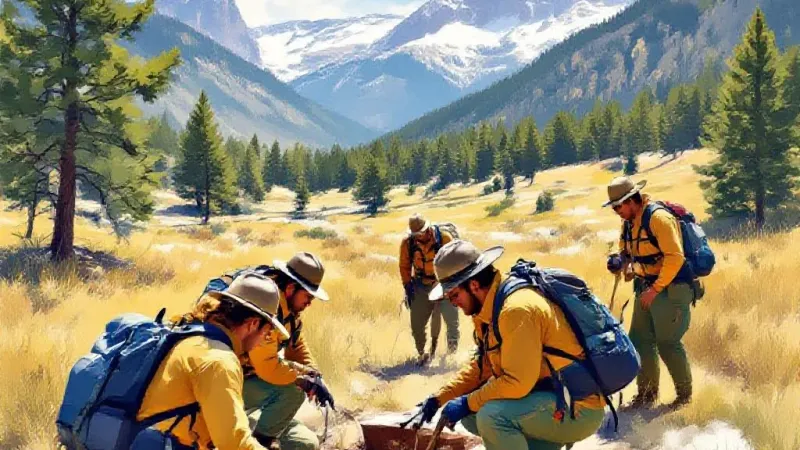
Estes Valley Fire Protection District volunteer firefighters are preparing for the upcoming fire season by undertaking their required annual training and certification processes. These preparations ensure they are ready to protect the Estes Valley from wildland fires.
A critical component of this annual readiness is the “Arduous Work Capacity Test,” commonly known as the pack test. This physical assessment certifies wildland firefighters each year. To pass, individuals must walk with a 45-pound weighted vest for three miles, completing the distance within 45 minutes. A specific condition of the test is that firefighters cannot run; the pace is described as between a jog and a fast walk, with both feet on the ground at all times. Community members might observe firefighters performing this test on the indoor track at the rec center, the outdoor track at the high school, or along the Lake Estes Trail in the coming months.
Beyond the physical demands, wildland firefighters undergo extensive classroom education. Initial wildland training includes several courses: S-130, S-190, and L-180, where “S” signifies suppression and “L” indicates leadership. These foundational classes instruct firefighters on essential skills such as fire line construction, suppression tactics, the proper use of personal protective equipment, firing operations, and critical safety protocols, even including how to hike effectively in rugged terrain. Over time, the approach to training has evolved into a blended style, integrating online content with practical field days to enhance learning. Safety remains a paramount concern, with firefighters required to memorize the 10 Standard Firefighting Orders. Adherence to these rules is so crucial that wildland firefighters have refused assignments when these conditions are not met. Additionally, their safety training covers 18 Watch Out Situations, which highlight circumstances requiring extreme caution. Annually, firefighters also complete an RT-130 classroom refresher, which reviews key wildland topics like fuels, weather patterns, and topography.
The training methods for today’s wildland firefighters largely mirror those from 25 years ago, a period when the Estes Valley Fire Protection District Chief, Kevin Nunn, first embarked on his wildland firefighting career. His path to wildland fire suppression and management began with early backpacking experiences in the Estes area during the early 1990s. Alongside Joe Coop, he ascended numerous peaks, including Twin Sisters, Flattop Mountain, Hallett Peak, Andrews Glacier, Mount Audubon in the Indian Peaks Wilderness, and Longs Peak, as well as explored areas like Thunder Lake, Lumpy Ridge, and Lawn Lake.
It was during these excursions, specifically along the Ouzel Falls Trail in Wild Basin, that storyboards describing the 1978 Ouzel fire captivated him, sparking an aspiration to become a wildland firefighter. This desire deepened after he moved to Fort Collins in 1994, while Joe Coop became a long-time resident of Estes Park. His early days of hiking taught valuable lessons in pacing, pushing physical limits, efficient backpack carrying, and the practical application of Emergency Medical Technician training for injury prevention. He also learned about calorie-dense food and multi-day journey packing, deepening his appreciation for nature and the outdoors.
The persistent question of how to become a wildland firefighter was answered in 2001 through training with Larimer County Emergency Services. His first experience battling a fire in the foothills above Fort Collins on the Fourth of July confirmed a natural affinity for the work, merging his hiking hobby with a passion for firefighting. He has been involved in wildland fire in some capacity ever since.
The Ouzel fire itself holds a significant place in the history of National Fire Management Policy. As a lightning-caused fire, the National Park Service initially permitted it to burn, a practice aimed at achieving resource benefits. This policy was in place until the fire threatened Allenspark. Since then, the agency, in conjunction with the National Wildfire Coordinating Group, has revised its natural fire management policy. While naturally ignited fires are still allowed to burn under specific conditions for resource benefits, the Ouzel fire stands as a notable example in this policy’s evolution.
Chief Nunn expects to see volunteer firefighters complete their annual pack test and classroom refreshers in the coming months. He notes that while some firefighters might be undertaking the test for the first time, he anticipates participating in his 26th year, continuing to combine his love of hiking with his commitment to firefighting. The community is encouraged to offer support to these dedicated individuals as they prepare for another season of protecting the Estes Valley.