
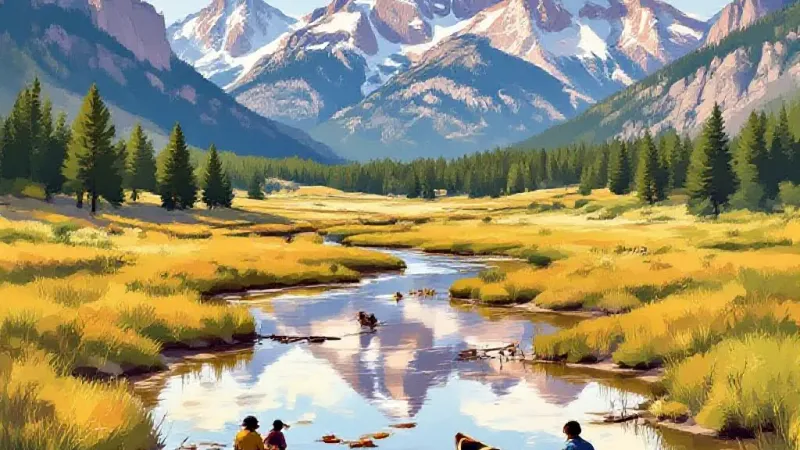
Rocky Mountain National Park's moose population is estimated at 240 as of 2025, according to a parkwide infrared aerial survey. This count, the first to sample the entire park, translates to a density of 0.259 moose per square kilometer. Will Deacy, a large mammal ecologist at Rocky Mountain National Park, indicated that this density is comparable to or even higher than some areas in Canada with moose. Deacy stated that "A heavy population density leads to an unhealthy population of moose."
Moose are a sought-after animal for visitors to the park and are the world’s largest member of the deer family. The Shiras subspecies, common in Colorado, typically weighs between 800 and 1,200 pounds. These animals are significant consumers of vegetation, with a bull moose capable of eating up to 70 pounds daily during the summer. Their summer diet is composed of about 90% willows, along with aspen shoots and leaves, submerged aquatic vegetation, alders, grasses, and forbs.
Most of this crucial vegetation thrives in the park’s wetland and riparian habitats, which were also identified as areas where moose concentrate during the aerial survey. While wetlands constitute only about 4% of the park, they support a rich diversity of species, including 32% of plants, 65% of rare plants, 45% of birds, and 20% of mammals. Given the moose population and their feeding habits, the park's moose could collectively consume over 10,000 pounds of vegetation daily in summer.
However, these vital habitats are under threat. Deacy reported that data show a loss of wetlands within the park. In the Kawuneeche Valley region, 98% of tall willow habitat has been lost since 1999, resulting in over-browsed shrubs and open grasslands, a phenomenon some ecologists call “zombie willows.” This decline has also led to a 94% reduction in beaver ponds, decreasing ecosystem biodiversity, increasing flooding, lowering water quality, and reducing protection from climate change, wildfires, and drought. Deacy emphasized the importance of these ecosystems, stating, “You need that connective tissue of an ecosystem.” The park's goal is to prevent further wetland loss and to be proactive, particularly on the park’s east side, to avoid similar habitat degradation seen in the Kawuneeche Valley.
Despite these ecological concerns, the moose population density in RMNP increased by 49% between 2020 and 2025. Approximately one in 15 Colorado moose reside in Rocky Mountain National Park. Historically, park biologists have questioned whether moose were native, sometimes labeling them as non-native or invasive. However, this perspective has recently shifted to acknowledging the occasional dispersal of moose into Colorado.
In 1978 and 1979, the Colorado Division of Wildlife, now Colorado Parks and Wildlife, translocated 36 moose from Utah and Wyoming into North Park, near RMNP’s northwestern boundary, for hunting and wildlife viewing purposes. The state’s moose population is now an estimated 3,600, one of the fastest-growing populations in the lower 48 states.
Further challenging the 'non-native' label, a recent study led by University of Colorado Boulder associate professor Will Taylor, titled “Understanding Ancient Moose Populations in the Southern Rocky Mountains,” provides new historical context. Archaeological records reviewed by Taylor and his team indicate that moose have been present in Colorado since about 10,500 B.C. The research team also found 34 historic-era records, dating back to 1860, mentioning moose. Taylor, an archaeozoologist who curates extensive collections of animal bones, initiated this project to trace historical records and ensure management decisions are "grounded in solid facts."
This debate over moose's historical status highlights a complex conversation in wildlife management: who determines what constitutes a non-native species and what information guides management decisions. Deacy affirmed that the park’s aim is to "protect the whole ecosystem," recognizing the challenge in managing a place like Rocky Mountain National Park. Taylor suggests that historical data, such as a palaeoecological database, can provide insights into current changes and their relationship to climate change, human activity, or predators.
Ultimately, the issue is framed as an ecological one rather than solely a moose issue. Studies suggest that habitat shrinkage and increased population density can lead to a greater spread of diseases within animal populations, increasing their vulnerability due to habitat loss, fragmentation, and environmental stress.